On Work

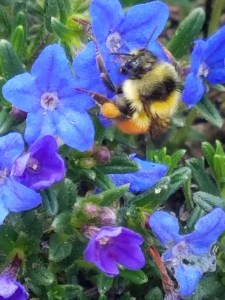
white_statice

“And what is it to work with love?

It is to weave the cloth with threads drawn from your heart, even as if your beloved were to wear that cloth.

It is to build a house with affection, even as if your beloved were to dwell in that house.

It is to sow seeds with tenderness and reap the harvest with joy, even as if your beloved were to eat the fruit.

It is to charge all things you fashion with a breath of your own spirit,
And to know that all the blessed dead are standing about you and watching.”

–Kahlil Gibran, “The Prophet”

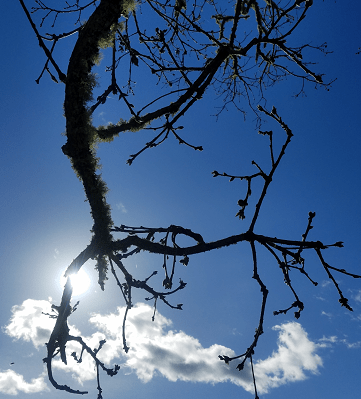
20170508 145715 resized

Aftermath

aftermath

The sun pushes upward into an empty city.

The triple tree-of-heaven, Ailanthus,

Toppled once to the east, twice to the west,

Roots a waking bear crack the pavement as it falls.

Wrack and wreckage,

Flotsam flung from a receding wave.

What did you lose?

What did you surrender?

Because there was no choice save surrender,

As sun and moon met the Earth Shaker.

Storm Warning

“And once the storm is over, you won’t remember how you made it through, how you managed to survive. You won’t even be sure, whether the storm is really over. But one thing is certain. When you come out of the storm, you won’t be the same person who walked in. That’s what this storm’s all about.”

― haruki murakami

Blue Iris

tiny_iris

Tiny blue iris surface among the dead leaves.

Just when it seems like a corner, the horizon flattens out, far flung to the line of sight, so far the pavement shivers, and it’s always been this, this winter hex, summer just a myth we share to keep us believing–I never walked barefoot over pink daisies in the lawn and there’s never been spotted fawns sparring on the hill, and my hands will never be warm again. I wonder if it’s August in South Africa and Australia. If yes, please write.

I flinch with every chime from my phone when it’s another advertisement for thumb drives in primary colors that I don’t want, although I’m not sure what I want exactly, just nothing that can be bought. February is one long damn month for the shortest one: Valentine displays are dismantled and lonely hearts lumped in sale bins marked down for quick sale. The full snow moon passed over but she’s still digging in her nails and not letting go. Rain rages down shooting ice pellets. I’m tired of this story.

Tiny blue iris surface among the dead leaves. I had to go down on my knees to sweep them free.

Praying

It doesn’t have to be
the blue iris, it could be
weeds in a vacant lot, or a few
small stones; just
pay attention, then patch

a few words together and don’t try
to make them elaborate, this isn’t
a contest but the doorway

into thanks, and a silence in which
another voice may speak.

–Mary Oliver


A Commonplace Book

crowbar

I’m selective about which books I buy now, there’s not enough shelving. I’m careless, anyway. Once finished, I’d toss the book under the bed until no more fit and pages spilled out into the aisle. I tripped on hardbacks in the night. The dog made a den under the bed and hides mangled toys there, so that’s no longer an option. I borrow books from the library. Sometimes I pay fines. There’s no excuse for it, but it’s true. It usually happens when no renewals remain, someone else requested the text, and I’m not ready to surrender.

Though confessing to carelessness with my own books, I take great care with borrowed ones. I do not fold down page corners. I flip through the pages to remove scraps of gift wrap or newsprint bookmarking before returning a library book; most solemnly, I do not mark the text or margins. It is dismaying to open a book and find underlining, bracketing and marginalia that is not ones own. It is distracting and rude. (Another confession: Not a fan of David Foster Wallace footnoting for approximately the same reason. However, I’m intrigued to find a previous borrower’s bookmark scraps to scrutinize for hidden messages.)

I read with a pen at hand, a fidget of concentration. I keep a small spiral notebook, the size of a generous postcard, with unlined pages as a commonplace book. I record notes and copy passages into this book. Although transcription is slow, and my handwriting is careless, tracing a sentence word-by-word tattoos it to memory’s skin whether or not the point is mastered:

“We are the wind chimes, not the wind,” a poet wrote about crafting her art.

“In essay, avoid the use of personal pronouns, although the essay must be personal,” Donald Hall writes in his “Essays after Eighty.” (I contemplate this advice while still unraveling it, obviously.)


Dog Magic

dog+magic

When I palm the tennis ball a new dog is confounded. I whisk the ball into a crook of the elbow and challenge the dog to find it. He lolls his tongue and shifts his eyes in a show of uncertainty. An inexperienced dog is baffled by sleight of hand. (Sleight: the use of dexterity or cunning, especially so as to deceive. A useful word.)

Mercy, the one-eyed pirate, grew up sitting through my tricks applauding with a thump from the tip of her tail. She knows them all now. She studied on the sleights. She knows a ball does not simply disappear, it is concealed somewhere nearby. New feints and magic ruses are met with skepticism. She trusts her nose, not her eyes.

Writing slowly, writing by hand. I type a fierce 90 words per minute, but what use is the page? Layers of bubble wrap is all it is; there may or may not be something valuable wrapped inside.

Common writing craft advice is “just write.” There is a post today on Brevity’s Nonfiction Blog advocating exactly this approach. It compares forcing out a first draft to purging after a night of binge drinking: write a draft, vomit words onto the page, go back later, edit, revise, rewrite. I understand. Some days I agree. Often trash sentences are better than freezing, better than no words at all. However, once words take up residence on the page that space is claimed by squatters. The mind settles on the done-ness of things, whether the work reads or not. We are easily misdirected. It’s dog magic.


Solstice | 2:23 PM December 21, 2018

solstice_12_21_18

The winter solstice is the moment the sun halts its southern descent and hangs holding the horizon on the Tropic of Capricorn, the place of the fish-tailed goat. The word solstice, a noun, derives from Latin and means simply the Sun stands still and there she lingers. Located halfway between the equator and North Pole on the 44th parallel, southern declination is sharp. By Christmas Day, the sun climbs north by an astronomical minute, a fraction of a degree.

To Juan at the Winter Solstice

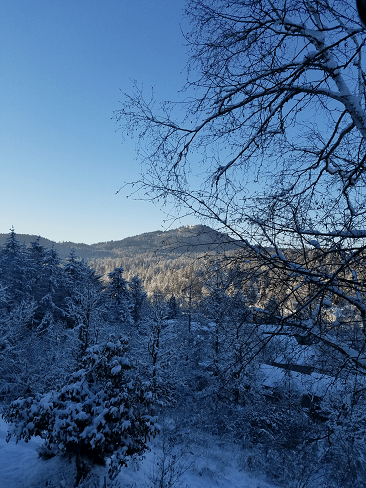
bute_in_snow

There is one story and one story only
That will prove worth your telling,
Whether as learned bard or gifted child;
To it all lines or lesser gauds belong
That startle with their shining
Such common stories as they stray into.

Is it of trees you tell, their months and virtues,
Or strange beasts that beset you,
Of birds that croak at you the Triple will?
Or of the Zodiac and how slow it turns
Below the Boreal Crown,
Prison to all true kings that ever reigned?

Water to water, ark again to ark,
From woman back to woman:
So each new victim treads unfalteringly
The never altered circuit of his fate,
Bringing twelve peers as witness
Both to his starry rise and starry fall.

Or is it of the Virgin’s silver beauty,
All fish below the thighs?
She in her left hand bears a leafy quince;
When, with her right hand she crooks a finger, smiling,
How many the King hold back?
Royally then he barters life for love.

Or of the undying snake from chaos hatched,
Whose coils contain the ocean,
Into whose chops with naked sword he springs,
Then in black water, tangled by the reeds,
Battles three days and nights,
To be spewed up beside her scalloped shore?

Much snow is falling, winds roar hollowly,
The owl hoots from the elder,
Fear in your heart cries to the loving-cup:
Sorrow to sorrow as the sparks fly upward.
The log groans and confesses:
There is one story and one story only.

Dwell on her graciousness, dwell on her smiling,
Do not forget what flowers
The great boar trampled down in ivy time.
Her brow was creamy as the crested wave,
Her sea-blue eyes were wild
But nothing promised that is not performed.

–Robert Graves

Woolgathering | A Note on Craft

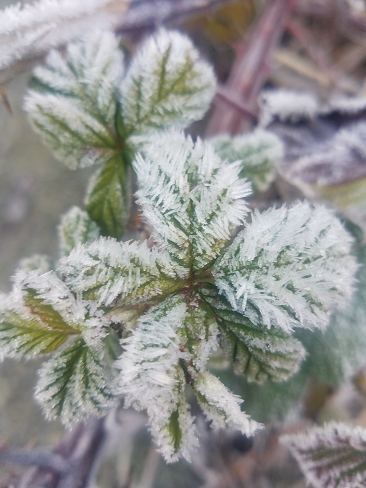
frost_blackberry

Woolgathering once literally referred to the act of gathering loose tufts of wool caught on bushes and fences as sheep passed by… by mid-16th century the word woolgathering came to suggest the act of indulging in purposeless mind-wandering.

Merriam-Webster Dictionary

Gather wool: hands forever stiff with plucking tufts from stiles and bramble.

Many or most get lost at the beginning, wandering about to find wool, a flock of sheep. Sheep do not volunteer to be stripped of their riches. Gathering wool is the chaotic business of first drafts, of culling a beast from the herd. The bleater must be driven through a chute into a small stifling shed. (Having a dog bred and trained for this purpose helps, but weaving a collie into this extended analogy is awkward.)

With the bawling sheep secured in the shearing shed, there is a tussle to throttle the beast and pin it to the straw. I confess I’ve never sheared a sheep, though I’ve hacked many dreadful first drafts. I’ve seen it done. It’s hot, dirty, bloody business, both for the shearer and the sheep. Words must be brawled down like fleece into a heap of filthy wool.

When the fleece is finally stripped and spread across the shed floor, the trembling sheep is allowed to return to pasture, a naked rustic muse. The creature spent the winter grazing in muddy pasture, dragging her belly through weeds rife with burrs, dribbling poop down her backside. Fouled wool will never do for knitting, no.

The fleece must be cleaned. First it must be skirted and then it must be washed. Skirting is vile work, but it is a first draft. Print out the pages, spread them across the kitchen table, and scan for chunks of dried poop, clumps of hay, cockleburs and caked mud. (Don’t overthink, we are nowhere near killing our darlings.) Pick out the noxious bits. A snippet from the Craftsy website applies so literally:

“Yellowed or brittle sections should be removed. You can always set some aside and come back to it later to see if it can be salvaged for other uses.”

Compromised wool unsuited to the current piece at hand might be recycled into a poem. While it’s wise to preserve a first draft intact in the raw original form, I am guilty of continually overwriting while revising. Someday I’ll open a folder for every project and save each file version. Perhaps one day I’ll organize my sock drawer and spice cabinet as well.

Toss aside the nasty bits. Throw them out. Passive voice, “to be” verb formations, tense disagreements, blundering word choices, all go into the black plastic bag. Next, stuff all the skirted wool into a mesh bag to wash. At this stage in writing, one pauses to ruminate, considering on the structure and thesis of the entire project. I ponder in the shower.

Sheep wool is covered in grease called lanolin. This natural oil is excreted from the body of the sheep and saturates its coat. Due to this oil, sheep are waterproof and able to contentedly graze over many days of soaking rain. One needs to wash away excess lanolin. We come to divide the worthy wool, the words that will stand, from the dross.

Fill a tub with hot water and squirt in a generous measure of liquid soap. Do not use your own washing machine as this will only result in remorse. Go for a walk. St. Augustine wrote that solutions arrive when walking (solvitur ambulando) and he seems trustworthy. Let the wool absorb the water and soap, but don’t let the water cool or the lanolin will not wash away.

Repeat four or five more times. Rinse well. Spread the wool out flat to dry for several days. Print the piece of writing. Place it on the kitchen counter, near enough to scribble in the margins between peeling carrots and chopping them. Let it sit. Make notes. Re-read the paragraph you were so proud of and strike it.  Reconsider and write “stet” in big block letters.

Once the wool is dry, comes teasing and carding. I have never done this. I am relying on the internet to help extend this metaphor as far as it will go. I do knit, however. I have observed other hardy handy souls carding wool and spinning it into yarn. Carding wool further cleans, straightens, and separates the fibers, hence the apt cliché of going over a page with a fine-tooth comb. It is here, finally, when you return to the work to restructure it, reinvent it, and rebuild it to be both worthy and whole.

After the wool is carded, it’s spun into yarn. This is an art unto itself, one that requires rhythm and tactile intelligence. This cannot be taught. This might be learned. Spinning is the nebulous writing gift talent. We will leave the spinner, a Clotho of the dark sisterly Moirai, to work her magic.

Only now and finally, is there a skein of yarn. Do not knit from this skein, as it will only tangle. Wind the yarn into a ball that will not ravel as it unrolls. As you wind, dream the words, hear their music, and smooth the stray strand back into the twisted fiber. Select the needles and note the pattern, count the stitches as you cast on.

Read the piece and read it again. Read until you know the words without reading them. Print another copy to leave at hand near the kitchen sink. Consider the root of each word; reconsider that phrase, chain by chain, stitch by stich, row by row, work through the yarn’s tension until the skein is dealt, the work ready to cast off. Bind it well.


knitting_basket